
Madison Release Mugshot Sources
The Madison County Sheriff’s detention page states that deputies photograph people during intake. It also says deputies process releases, transports, and daily jail records. Those facts show that booking images and release records are created, but the reviewed official pages do not publish a rolling recent-release mugshot feed, a photo archive period, or a sheriff mobile app with release photos.
The sound local path is a narrow records request. Ask for the booking photograph from one identified booking episode and separately ask for the release disposition. That response can distinguish release to the community from transfer to IDOC, ICE, another county, or another agency. A photo by itself cannot make that distinction.
Request Madison Booking Photographs
Use the official Madison County NextRequest portal. Name the record rather than requesting every photo or all bookings in a date range. Include the full name, date of birth if known, approximate booking date, and case or booking number. Ask for the image created during that booking and the related release line, including timestamp, reason, and destination if transferred.
- Confirm the person and booking through MCSO or the Madison County case.
- Open the county records-request portal.
- Describe the specific booking photograph and booking episode.
- Request release disposition and receiving agency as separate context.
- Ask for a fee estimate and preferred electronic delivery.
No flat MCSO booking-photo fee was published in the sources reviewed. Do not quote one. The custodian may redact or withhold material under Idaho law, a court order, juvenile rules, privacy protections, or an active investigation. If part is denied, ask for the cited basis and any reasonably separable nonexempt material.
Verify Madison Mugshot Identity
A common name and a face are not enough. Match at least two facts beyond the name, such as date or year of birth, booking number, case number, agency, booking date, or offense. Names can be misspelled, photos can be attached to the wrong entry, and old images can survive after a source record changes.
| Item | Use | Limit |
|---|---|---|
| Booking photo | Documents the intake image | Does not establish guilt or release |
| Booking number | Connects the image to one episode | May be local to the agency |
| Release disposition | States how MCSO custody ended | May name a transfer, not freedom |
| iCourt case | Shows general case events | Summary may omit the full order |
| Source date | Shows when information was checked | Can become stale |
If identity or context conflicts, pause publication or use. Ask the record custodian to correct the source. A later court disposition should be attached to the photo context rather than allowing the arrest image to imply the whole case outcome.
Madison Mugshots Need Release Context
Read the image beside the booking and release episode. MCSO’s record may say bond posted, court-ordered release, time served, sentence completed, dismissal, transfer to IDOC, or transfer to another agency. Do not translate an internal code without the custodian’s key. The booking release timestamp marks when county custody ended, while the court-order date and sentence-satisfaction date answer different questions.
Use Idaho iCourt for general Madison County case information. Search by name, narrow to the county and likely date, and match the case number. Look for bond, dismissal, judgment, commitment, probation, and satisfaction events. When the summary is unclear, request the actual order from the Madison County Clerk under Idaho Court Administrative Rule 32.
Absence from a current roster does not prove community release. A person can leave Madison County custody and enter IDOC or ICE custody. Pair the MCSO disposition with the receiving system when a transfer appears.
County Versus State Release Photos
A county booking photo and an IDOC correctional image have different custodians and contexts. Request the former from MCSO. An IDOC client detail may show a state correctional image depending on the public interface, while an available identifying photograph may be requested through the IDOC public-record portal. Neither should be presented as the other.
| Image source | What it concerns | Status check |
|---|---|---|
| MCSO booking photo | Madison County jail intake | MCSO release record and iCourt |
| IDOC image | State custody or supervision record | IDOC Resident and Client Search |
| Registry image | A current statutory registration record | ISP registry or OffenderWatch |
| News image | Publication at a past point in time | Originating agency and court record |
The Idaho Sex Offender Registry applies only to people with a statutory registration duty. It is not an archive of all released inmates and does not establish that a sentence ended. Keep its images and purpose separate.
No Madison Mugshot Release Feed
No official rolling Madison County recent-release photo view was located. MCSO maintains daily jail records, but that statement does not promise a public 24-hour or 72-hour archive. The absence makes a named booking-episode request more reliable than a screenshot of a current roster or a commercial gallery.
Commercial aggregators can carry stale, incomplete, or misidentified data and may fail to add a dismissal, transfer, or later disposition. They are not release proof. An arrest story also shows what was published then, not current status. Verify at the sheriff, court, IDOC, or receiving agency as the event requires.
No official Madison County sheriff app advertising recent-release mugshots was found either. OffenderWatch, CodeRED, and social links serve other purposes and should not be relabeled as a jail-photo service.
Shielded Madison Records and Mugshots
Idaho’s Clean Slate Act guidance describes shielding, not destruction. Eligible applicants generally must wait at least five years after completing the entire sentence, including supervision, fines, and restitution, and relief is limited. A shielded court record becomes less accessible to the public, but lawfully held copies do not automatically vanish.
That limit does not justify presenting an old mugshot without current context. If the official source becomes shielded, corrected, or restricted, reassess the image and its caption. Remove or correct a photograph when identity is wrong, a court order or law restricts access, or the source record changes. Do not rely on a pay-to-remove publisher as legal authority.
The official Clean Slate instructions identify case, disposition, supervision-completion, financial-condition, and eligibility inputs. They are the proper source for the court process, not a third-party photo page.
Caption Madison Release Mugshots
A factual caption should state the image source, booking agency, booking date when verified, and the limited event shown. Add the release disposition and court outcome only when supported by their own records. Include a checked date so later readers can tell when the context was last confirmed.
- Identify MCSO as the source only when MCSO supplied the image.
- Label the booking date separately from the release date.
- State “transferred” when the record names another custodian.
- Add the case disposition from the court source.
- Correct or remove materially inaccurate context.
Neutral wording protects accuracy and dignity. Avoid sensational labels. A booking image is one record from one point in a case.
Idaho Law and Madison Photos
Idaho public-record law begins with a right to inspect or copy records, subject to exemptions and agency review. Title 74, chapter 1 supplies the response, fee, and exemption framework. Sections 74-105 and 74-124 can protect investigative material when disclosure would interfere with enforcement, impair a fair trial, invade protected privacy, reveal protected sources or methods, or endanger people.
The research found no categorical Idaho booking-photo exemption. That does not create an automatic sheriff duty to publish each image. MCSO must review the request under current law, court orders, privacy rules, and case facts. Ask for the legal basis when access is denied or redacted.
Basic arrest information and protected investigative detail differ. Frame the request around one booking photo and release record, not the whole investigative file.
Correct Madison Mugshot Records
Send a correction to the custodian that created the disputed record. MCSO handles its booking photo and release entry. The Madison County Clerk handles court records. IDOC handles its client image and sentence fields, while Idaho State Police handles the statewide registry.
Describe the exact error and attach a reliable record. A wrong identity may require facts that separate namesakes. A missing dismissal or amended judgment calls for the filed court document. A transfer mislabeled as community release calls for the MCSO disposition and receiving-agency record.
After the source is corrected, update or remove downstream copies under applicable rules. Continuing to display a known mismatch can mislead even when the image was lawfully obtained.
Madison Release Photo Boundaries
A photo cannot replace a custody search. Verify a Madison County release through MCSO status and the release record. Verify a state transition through IDOC. Use the court case to learn why the event occurred. If a receiving agency is named, check that system next.
News and press images document publication at a past point. They do not establish final disposition. Registry photos have a narrow statutory context. Commercial collections often omit later case or custody changes and are not a sound final source.
The best evidence is a linked chain with dates and labels: booking image, release disposition, court outcome, and receiving status when transferred. Keep each claim tied to the office that proves it. Add the date each source was checked because a later order or correction can change the proper context.
View Madison Photo Request Access
The official Madison County records-request interface is the documented route for a narrowly identified booking photograph.
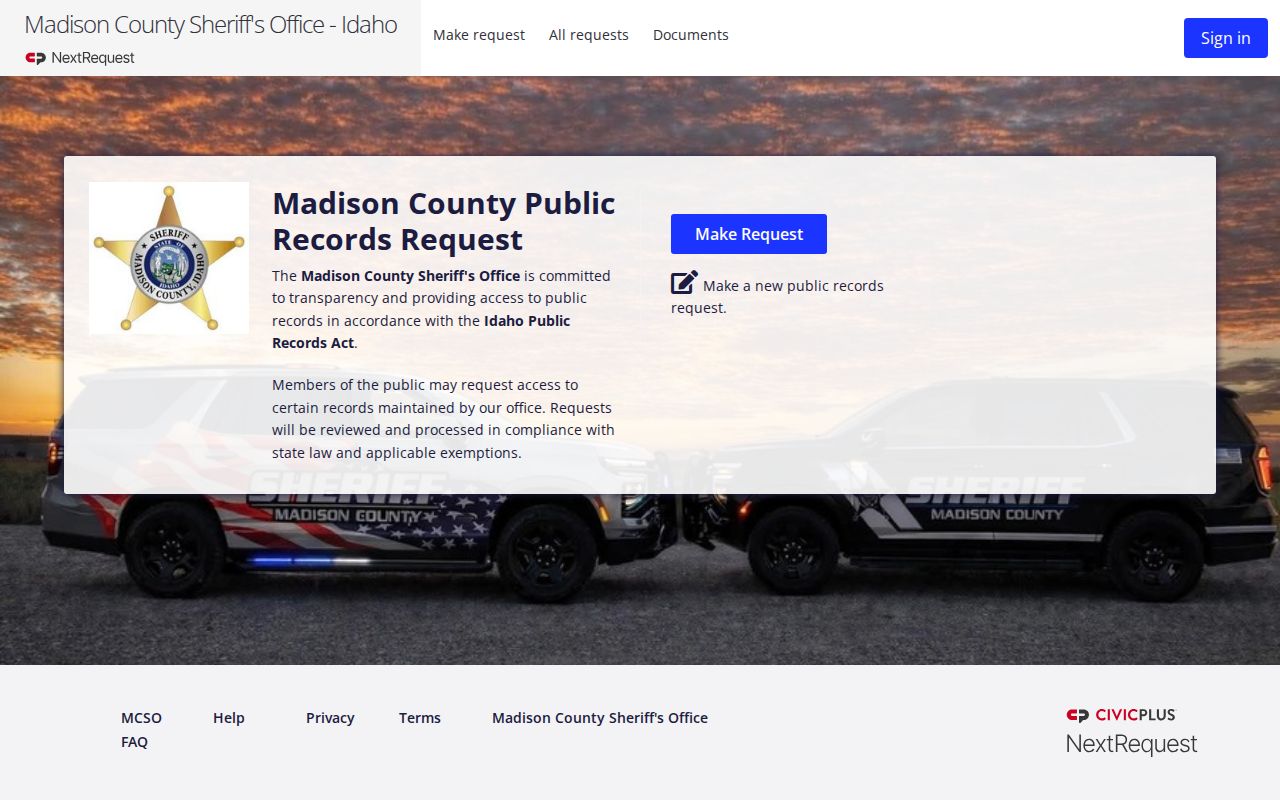
This source route preserves the booking episode and custodian. Request disposition context with the image instead of building conclusions from a photo alone.